Fire Safety Declaration for STR 2026: PDF Template + Guide
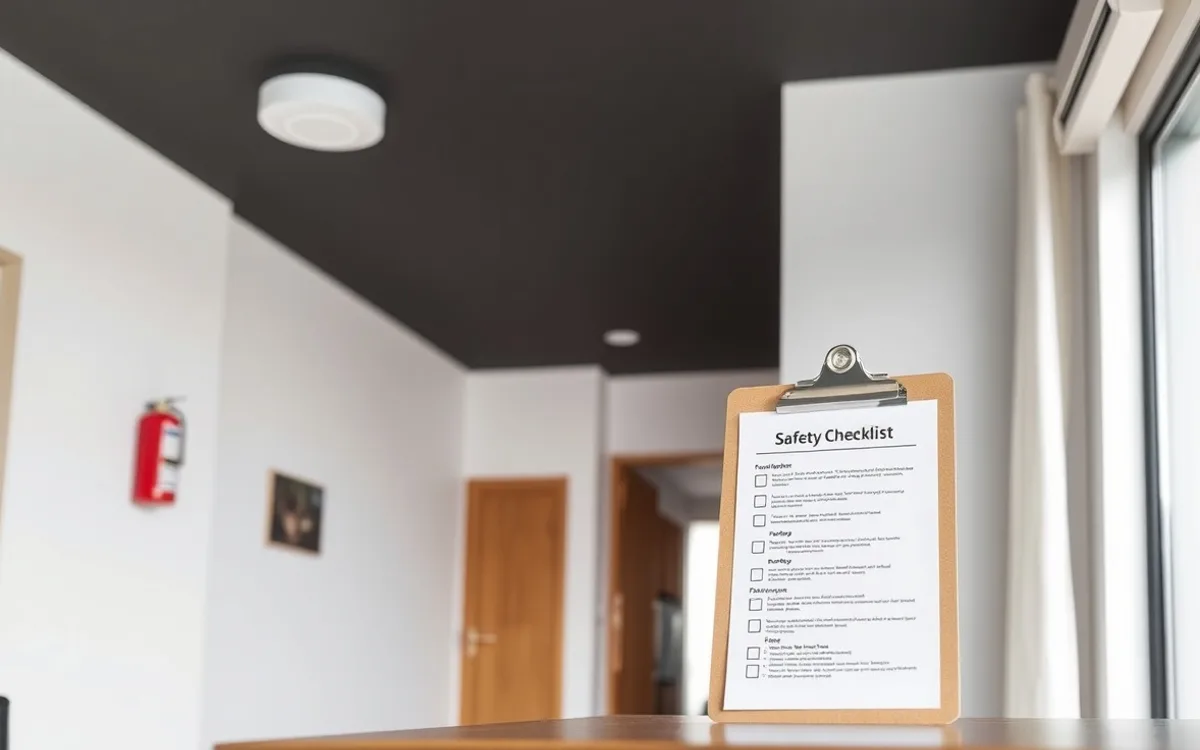
The fire safety declaration is a mandatory CWTON attachment. Free PDF template, step-by-step instructions, and the mistakes that cost up to PLN 10,000.
READY-MADE STR DOCUMENTATION
Get your documents ready in 2 evenings.
Before your municipality asks.
Instead of writing documents from scratch (40+ hours) or paying a lawyer (£1,500+), download ready-made templates aligned with Polish STR law and the UC135 bill.
Fire Safety Declaration for CWTON - Free Template and Step-by-Step Guide
CWTON (Central Register of Tourist Accommodation) registration requires submitting a fire safety compliance declaration. Sounds intimidating? In practice, it's one of the simpler documents - as long as you know what to include and your apartment actually meets the requirements. In this article, you'll find detailed instructions for completing the fire safety declaration, a list of the most common mistakes, and information about what equipment you need before signing it. At the end, I'll point you to where to find a ready-made template and how to avoid a fine of up to 10,000 PLN for submitting a false declaration.
Key takeaways
- The fire safety declaration is foreseen in the draft CWTON implementing act - it's a provision of a draft bill, not law currently in force. The CWTON registration system has not yet launched, so for now there is nowhere to actually "submit" it
- Independently of CWTON, a hard safety requirement applies: smoke detectors will be mandatory in existing short-term rental units from 30 June 2026 (Ministry of Interior regulation of 21 November 2024), and a carbon monoxide detector where fuel is burned
- You must have at minimum: smoke detectors, a fire extinguisher, and an evacuation plan - if fuel is burned in the unit (gas, fireplace), a carbon monoxide detector is also required
- You don't need a firefighter inspection - you make the fire safety compliance declaration yourself, but you must tell the truth
- Fire safety equipment costs 200-500 PLN - a one-time investment that protects you legally and saves your guests' lives
What is the fire safety declaration and why does CWTON require it?
The fire safety declaration (oswiadczenie ppoz.) is a document in which you, as a host, declare that your accommodation property meets basic fire safety requirements. It's not a fire brigade inspection report or a technical assessment - it's your own declaration, submitted under penalty of criminal liability.
Where does the fire safety declaration even come from? EU Regulation 2024/1028 (applicable from 20 May 2026) concerns the collection and exchange of data about properties - it does not directly impose fire safety obligations on the host. The fire safety compliance declaration instead appears in Poland's draft implementing act (UC135), which is meant to establish the CWTON system. The act has not yet been passed and the registration system has not launched - so treat the declaration as something worth preparing for, not a document you already submit somewhere today.
Regardless of what happens with CWTON, the obligation to ensure fire safety is real. Guests don't know the layout of your apartment, they don't know where the emergency exits are, and they have no idea whether there's a fire extinguisher in the kitchen. And from 30 June 2026, smoke detectors in existing short-term rental units become mandatory under the Ministry of Interior regulation of 21 November 2024 - this is a hard requirement that takes effect independently of the CWTON act.
Even once the CWTON system launches, it won't physically check whether you have a smoke detector in every room. But be aware - a safety inspection (e.g., by the fire brigade) may come independently. If it turns out the actual condition differs from what you declare, you face consequences. More on that in a moment.
If you don't yet know what the entire registration process looks like, start with our guide: How to Register with CWTON - Step-by-Step Guide.
What exactly must the fire safety declaration contain?
The fire safety declaration submitted as part of CWTON registration must confirm that your property meets several specific requirements. It's not enough to write "the property is safe" - you must address specific equipment and procedures.
1. Smoke detectors
You must confirm that functioning smoke detectors are installed in the property. The minimum configuration is a detector in every sleeping room (bedroom) and along the evacuation route (hallway, entrance hall). In practice, it's worth installing a detector in the living room as well.
Detectors must be functional and have valid batteries. The best solution for short-term rentals is detectors with a built-in 10-year battery - you don't have to worry about the battery dying between guest stays.
2. Fire extinguisher
The declaration requires confirmation that the property has a fire extinguisher of appropriate capacity. For a standard apartment (up to 100 m2), one 2 kg ABC powder fire extinguisher is sufficient. The fire extinguisher must have a current technical inspection - the date of the next inspection is on the sticker.
Read more about fire extinguisher requirements and placement in the article Fire Safety Requirements for Short-Term Rentals.
3. Evacuation plan
You must declare that the property has an evacuation plan available to guests. An evacuation plan is a simple graphic showing the apartment layout, evacuation routes, the location of the fire extinguisher and smoke detectors, and the emergency number 112. It doesn't need to be a professional architectural drawing - a clear diagram displayed in a visible location (ideally on the inside of the front door) is sufficient.
4. Carbon monoxide (CO) detector
If your property has fuel-burning appliances (gas furnace, gas stove, fireplace, gas water heater), you must have a carbon monoxide detector. The basis is the Ministry of Interior regulation of 21 November 2024, which - for existing units providing accommodation services (including short-term rental) - introduces a smoke-detector requirement from 30 June 2026 and, where fuel is burned, a carbon monoxide detector as well. This is not optional but a requirement now coming into force.
In units with central heating and an electric stove (no fuel burned), a CO detector is not formally required, but many experts recommend installing one as an additional safety measure.
5. Marked evacuation routes
In the declaration, you confirm that evacuation routes are marked and unobstructed. In practice, this means the hallway leading to the front door is free from obstacles, and the front door can be opened from the inside without a key (or the key is in a visible, marked location).
How to complete the fire safety declaration step by step
Completing the declaration isn't complicated, but it requires attention. Here's the detailed procedure:
Step 1: Check the actual condition
Before filling in anything, walk through your apartment with a checklist. Verify:
- Whether smoke detectors work - press the test button on each detector
- Whether the fire extinguisher has a current inspection - check the date on the sticker
- Whether the evacuation plan is displayed and legible
- Whether the CO detector works (if applicable to your property)
- Whether the evacuation route is free from obstacles
If anything is missing - first get the equipment, then fill in the declaration. The order matters.
Step 2: Download the declaration template
The fire safety declaration template should be available on the CWTON platform as part of the registration form. If you prefer a ready-made document with pre-filled fields, the HostReady Package includes a ready-made declaration template tailored to CWTON requirements.
Step 3: Fill in identification details
At the beginning of the declaration, enter:
- Your full name (or business name if you rent as a registered business)
- PESEL or NIP (personal identification number or tax identification number)
- Property address - the exact address of the apartment, including the unit number
- Date of completion
Step 4: Mark the requirements you meet
The declaration contains a list of requirements where you indicate that your property meets them. The typical structure consists of checkboxes or statements like "I confirm that the property has...":
- Functioning smoke detectors in sleeping rooms and along evacuation routes
- A fire extinguisher with a current technical inspection
- An evacuation plan available to guests
- A carbon monoxide detector (if there are gas appliances in the property)
- Marked and clear evacuation routes
- Emergency number 112 information available to guests
Step 5: Sign the declaration
You sign the declaration electronically (using a profil zaufany, or trusted profile) as part of the CWTON registration process, or - in some cases - by hand if you submit it in paper form. Remember: your signature means you take full responsibility for the accuracy of the information.
Most common mistakes when completing the fire safety declaration
Based on the experiences of hosts who have already gone through the registration process, we've compiled the most common mistakes. Avoid them, because they can cost you not only time but also money.
Mistake 1: Signing the declaration without checking the actual condition
This is the most serious and most common mistake. A host clicks "confirm" on all points without checking whether the smoke detector in the bedroom even has a battery. Then an inspection comes, the detector doesn't work, and the host has a problem - because they submitted a false declaration.
Solution: Before completing the declaration, physically walk through the apartment and test every piece of fire safety equipment.
Mistake 2: Expired fire extinguisher inspection
You have a fire extinguisher? Great. But when was it last inspected? A fire extinguisher requires inspection at least once a year. An expired inspection means your declaration about having a functional fire extinguisher is technically untrue.
Solution: Check the date on the sticker. If the inspection is overdue, arrange one before registration. The cost is 20-40 PLN.
Mistake 3: Omitting the CO detector in an apartment with gas
Many hosts forget about the carbon monoxide detector because "I already have a smoke detector, that's enough." It's not enough. A smoke detector does not detect carbon monoxide. If the apartment has a gas furnace or gas stove, a CO detector is mandatory.
Solution: Check what heating source and stove type you have in your apartment. If anything burns gas - buy a CO detector.
Mistake 4: Evacuation plan hidden in a drawer
Simply having an evacuation plan isn't enough. The plan must be displayed in a visible location. A guest who arrives at the apartment at 11:00 PM after a long journey won't be searching for it in a nightstand drawer.
Solution: Display the plan on the inside of the front door or in the hallway at eye level.
Mistake 5: Incorrect property address
Entering the building address without the unit number or getting the apartment number wrong is a formal error that can delay registration. The CWTON system requires the exact address including the unit number.
Solution: Check the address in the deed of ownership or lease agreement and copy it exactly.
Consequences of submitting a false declaration
This is not an empty threat. Submitting a false declaration in the CWTON registration process carries real legal consequences.
Financial penalty of up to 10,000 PLN
For submitting a declaration that doesn't match the actual condition, you face an administrative penalty of up to 10,000 PLN. This is a separate penalty from the one for not registering with CWTON (up to 50,000 PLN). Theoretically, you could receive both at once - no registration plus a false declaration.
Removal from the register
If an inspection reveals that your declaration was untrue, the authority maintaining the register may remove your property from CWTON. This means losing your registration number, and therefore the obligation to remove your listing from booking platforms - at least until re-registration.
Criminal liability
Criminal liability for a false declaration (Art. 233 of the Kodeks karny, the Criminal Code, for making false statements) only comes into play when a specific statute expressly provides for the declaration to be made under penalty of such liability and includes the corresponding formal caution. Because the CWTON implementing act has not yet been passed, there is today no basis to speak of criminal liability on this ground. A separate - and already real - matter is liability for actual safety failures, if they were to contribute to endangering guests' life or health.
In summary: it's not worth the risk. Fire safety equipment costs a few hundred zlotys, and this is about the real safety of your guests - not a formality.
Fire safety equipment - what to buy, where, and for how much?
Before you complete the declaration, you need to have the right equipment. Here's the shopping list with approximate prices:
Smoke detectors
- Photoelectric detector with 10-year battery - 40-80 PLN each
- You need at least 2-3 units (bedrooms + hallway)
- Where to buy: Castorama, Leroy Merlin, OBI, Allegro, Amazon
- Total cost: 80-240 PLN
ABC powder fire extinguisher 2 kg
- Price: 50-90 PLN
- Annual inspection: 20-40 PLN
- Where to buy: hardware stores, fire safety shops, Allegro
- Wall bracket: often included with the extinguisher, separately 10-20 PLN
Carbon monoxide (CO) detector
- Price: 50-120 PLN
- Required only if you have gas appliances
- Where to buy: same places as smoke detectors
Evacuation plan
- DIY: 0 PLN (you can draw it yourself or use a free graphic tool)
- Ready-made template to fill in: available in the HostReady Package
- Professional plan from a designer: 100-300 PLN
- Frame for the plan: 10-30 PLN
Cost summary
Minimum fire safety equipment for a standard apartment (without gas) costs around 200-400 PLN. With a CO detector and professional evacuation plan - up to 500-600 PLN. This is a one-time investment (aside from the annual fire extinguisher inspection at 20-40 PLN) that protects you legally and - more importantly - can save your guests' lives.
How does the fire safety declaration connect to CWTON registration?
The fire safety declaration is one element of the CWTON registration process. It's not a separate document you send by post - it's an integral part of the registration form.
The process looks like this:
- You log in to the CWTON platform using a profil zaufany (trusted profile)
- You fill in property details - address, type, number of rooms, capacity
- You submit declarations - including the fire safety declaration
- You send the application
- You receive a registration number
Under the draft act, the fire safety declaration is meant to be an integral part of the registration application. The exact flow will only be known once the act is passed and the system launches - the steps above describe the planned shape of the process, not a procedure that works today.
You'll find the full list of documents needed for registration in the article Short-Term Rental Document Checklist.
Preparing for a potential inspection
Submitting the declaration isn't the end of the story. An inspection can come at any time - from the fire brigade, sanitary inspection, or the authority maintaining the CWTON register. How should you prepare?
Photographic documentation
Take photos of the installed fire safety equipment with a visible date. Photograph:
- Each installed smoke detector
- The fire extinguisher with the visible inspection sticker
- The displayed evacuation plan
- The CO detector (if applicable)
- Clear evacuation routes
These photos may come in handy not only during an inspection but also in case of insurance claims.
Document archive
Keep copies of:
- The submitted fire safety declaration
- Fire extinguisher inspection reports
- Receipts for fire safety equipment purchases
- Detector certificates (if available)
Regular updates
Check the condition of fire safety equipment during each cleaning between guests or at least once a month. Especially test smoke detectors - just press the test button. If a detector doesn't respond, replace the battery or the entire detector.
Frequently Asked Questions
Is the fire safety declaration mandatory for CWTON registration?
In the draft CWTON implementing act, the fire safety declaration is foreseen as a mandatory element of the registration application. But this is still a provision of a draft bill - the registration system has not launched, so today there is nowhere to actually "submit" this declaration. It is worth preparing in advance, though, because the actual fire safety equipment (including smoke detectors, mandatory from 30 June 2026) is needed regardless of CWTON.
Who can sign the fire safety declaration?
The declaration is signed by the property owner or a person with the right to manage it (e.g., a tenant with subletting rights). If you register as a business, the declaration is signed by the authorized representative - the sole proprietor, the company's board president, or a pelnomocnik (authorized agent). You don't need a firefighter's or fire safety expert's signature.
Do I need a firefighter inspection?
No. CWTON registration does not require a fire brigade inspection. You submit the declaration on your own responsibility. However, the fire brigade may conduct an inspection at any time after registration - and will then check whether the declaration matches the actual condition. That's why it's not worth lying on the declaration.
What if my apartment is in an apartment building - do I still need a fire extinguisher?
Yes. Even if the building's stairwell has fire extinguishers and hydrants, your short-term rental apartment should have its own fire extinguisher. In case of danger, a guest won't run around the stairwell looking for a fire extinguisher on another floor. A 2 kg ABC powder fire extinguisher costs 50-90 PLN - that's really a small expense compared to the potential consequences.
How often does the declaration need to be updated?
You submit the declaration once - at the time of registration. You don't need to renew it every year. However, if the fire safety equipment status changes (e.g., you remove a gas furnace and therefore a CO detector is no longer needed, or conversely - you install a gas stove), you should update your information in CWTON. Also remember that fire safety equipment requires ongoing maintenance: fire extinguisher inspection annually, detector testing monthly, detector replacement every 10 years.
Summary
The fire safety declaration is an element foreseen in the draft CWTON act - today there is not yet a system in which you would submit it, but the equipment itself is worth having regardless: from 30 June 2026, smoke detectors in existing short-term rental units are mandatory under the Ministry of Interior regulation. The good news: completing the declaration is straightforward, and the cost of fire safety equipment is a one-time 200-500 PLN. Key principles: first buy and install equipment, then complete the declaration. Don't sign anything that doesn't match the actual condition. Take photos. Archive documents. And remember about annual fire extinguisher inspections.
Don't want to search for templates and regulations on your own? The HostReady Package includes a ready-made fire safety declaration template, evacuation plan template, and a complete fire safety equipment checklist - ready to fill in and submit to CWTON right after purchase.